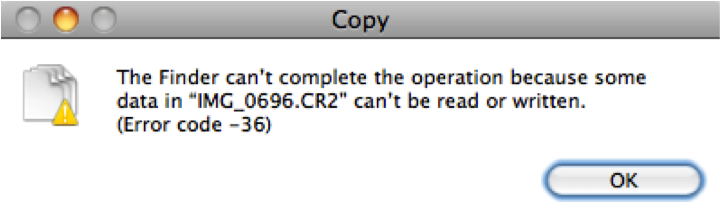
I mostly copy all my photos to external drive and later have a look at them. The copying files from CF card of new Canon M-IV to my macbook pro in the Finder takes place using CMD+C in the card directory and pasting to my external drive using CMD+V. I have been using RAW files for many years, and doing this copying process many times I never had an issue. But recently, this error poped-in saying:
"The finder can't complete the operation because some data in can't be read or written. (Error code-36)"
After this message, copying stops.
My thought was that some files got corrupted.so I shall still copy other files that are not. I started to copy files individually and realised that there are lot of files which cannot be copied.
While looking at those .CR2 files which cannot be copied, I realised their previews were totally dark or half of the photo with random patterns. This observation brought an attention to the fact that none of the uncopyable files had previews, but has a normal large file size (20mb to 35mb) for RAW files from new DSLRs. This happened because there were many files and it takes sometimes for Finder to read the contents and possibly create previews for each file. For some reason, it could not copy these files without knowing the contents?!?!?
Anyways, what I planned was to make a copy of rest of the files without stopping in case of error.
My option was to use Terminal, and use -Rp option to copy the folder from CF card to external drive. Reading man page of cp,:
Using following command did the trick:
cp -Rp "/Volumes/< source Volume name > / < source folder name >/" "/Volumes/< destination Volume name >/< destination folder name > /" One easy way to easily put folder location would be to drag the corresponding folder while writing source and destination folder address, For example, type cp-Rp, space, drag source folder to Terminal, the press space, and drag and drop the destination folder. Press Enter.
This command starts the slow but good process of copying files with their original atributes and cotinue copying even if there is an error. After sometimes the command ended with error mentioning that two (named) files were not copied. I changed the command and tried this:
cp -Rp "/Volumes/// " "/Volumes//"
cp -Rp "/Volumes/< source Volume name > / < source folder name >/ **" "/Volumes/< destination Volume name >/< destination folder name > /"
With that, I was able to copy all the files. Just out of curiosity, I tried to copy the whole folder to new location and it did copy it smoothly without error. This means that the time I was copying the files using terminal, Finder had managed to create a preview of all the files and thus copy went without error.
I hope that this process will help others as well. Let me know if you have similar experience and your solution for this issue,
Have been using Filezilla for so long, but one feature I was missing was to pause and resume upload feature. It was not missing but with just different name "Process Queue"
You can find this feature in the Transfer menu (in mac version):
To Pause: During the transfer, go to "Transfer" menu and uncheck "Process Queue" To Resume: Go to "Transfer" menu and check the "Process Queue"
As I understood, this "resume" feature should work even after you quit Filezilla after the "pause" and later open the application.
Have you tried this feature before? Hopefully someone else find this useful as well.
There are situations when I have some application which was running completely fine and one just fine morning, it just doesn't work, for some reason. Sometimes the configuration file is corrupted, port misconfiguration, installation files corrupted and a list can go on.In any case, you try to make it work by changing settings, installing-uninstalling, restarting but still IT DOES NOT WORK. Recently I had this situation with one SIP app which I have been using for long and even though it had its glitches it worked after a while but not this time.
I tried all solution searching from different forums but nothing. The solution came only after a "complete and clean uninstall". If you didn't know what it is, don't blame yourself. Many of us, as being mac users, we fancy going to application folder and removing an application by CMD + DEL; and most of the time it works. But some applications do have special files and service files that do not get removed with simple removal of an application file. Sometimes cleaners, like what I use CCleaners, are good in finding residual files but not always. Anyways, there are several clean uninstallers out there, but for me this free "AppCleaner" did its task.
After installation from App-store and allowing permission to Application folder on my mac, it listed all the application installed.
I clicked on the application which was having a trouble, it listed all folders and files related to selected application.
I selected all files and press "Remove selected files" button.
Then I went to "Applications" folder in finder and remove the app with usual CMD+DEL (You can also remove the main application from pro-version of AppCleaner. )
The after secure empty trash, I restart the computer.
Then I reinstall my app, and it just started to work as it was before.
System: OS X Yosemite, 10.10.5, MacBook Pro
Did this tip helped you in anyways? Do you have any other tips or similar application configuration solution, please leave it in comments below.
I hope this solves some of your problem too. If your PhoneGap app says that "Server is running" with given IP Address and port, chances are that the app is serving the files through it server well.
I didn't need internet in my mobile device so I was working offline. However, my device when I try to connect through Phonegap Developer app in mobile device gives: "Error" .... "Time Out" message. Obviously some problem with connection?
I connect back to mobile internet in device, but no, the problem still persists. Then I connect to my wifi network, and Problem Solved! Yes, I realised that the way it works is like a intranet. The reasons this happened was my computer and device were not in the same network, this does not have to be related to internet but just same network so that the IP address that Developer app is serving the files can be reached by device. Like simple server/client system, thats is only possible if they are in same network. Hopefully this solves few minutes of your wondering and pondering
sometimes the computer is put for hibernate many times when the eclipse is still working or
resources gets called too early before the instance of workspace can be created, or
Eclipse did not shutdown correctly.
And eclipse might crash (freeze on splash) with messages like (check workspace\.metadata\.log)
!ENTRY org.eclipse.core.resources 2 10035 2011-07-12 00:32:14.925
!MESSAGE The workspace exited with unsaved changes in the previous session; refreshing workspace to recover changes.
It might need to starting everything with a new workspace and then set up all the projects again properly (takes hours to do). Some solutions that can be worth trying :
remove folder workspace\.metadata\.plugins\org.eclipse.core.resources\.root\.indexes
and restart Eclipse (Referenced here) . Good to rename rather than delete because some also metioned that there was some other problem after that.
Go to: \.metadata\.plugins\org.eclipse.core.resources and remove the file .snap Or remove file : .metadata\.plugins\org.eclipse.core.resources\.projects\<project>\.markers.snap. This is a large snapshot file which Eclipse constantly polls for some projects. (Referenced from here )
The third solution (which worked for me) is when workbench is restarted/quit, then its need to save the workspace, before existing the workbench then the above message comes.
Overload the preWindowShellClose() method in your of WorkbenchWindowAdvisor. You can save the workspace by using ResourcesPlugin.getWorkspace().save(...) method. (Sited here)
public class ApplicationWorkbenchWindowAdvisor extends WorkbenchWindowAdvisor {
// other methods...
@Override public boolean preWindowShellClose() { try { // save the full workspace before quit ResourcesPlugin.getWorkspace().save(true, null); } catch (final CoreException e) { // log exception, if required }
This error/exception belongs to wrong Run Configurations in the project.:
osgi> !SESSION 2010-09-23 17:05:21.083 ----------------------------------------------- eclipse.buildId=unknown java.version=1.6.0_20 java.vendor=Sun Microsystems Inc. BootLoader constants: OS=win32, ARCH=x86, WS=win32, NL=en_US Framework arguments: -product etdeltatm.rcp.ui.product Command-line arguments: -product etdeltatm.rcp.ui.product -data C:\Documents and Settings\bkhanal\workspace/../runtime-etdeltatm.rcp.ui.product -dev file:C:/Documents and Settings/bkhanal/workspace/.metadata/.plugins/org.eclipse.pde.core/etdeltatm.rcp.ui.product/dev.properties -os win32 -ws win32 -arch x86 -consoleLog -console
!ENTRY org.eclipse.equinox.app 0 0 2010-09-23 17:05:22.614 !MESSAGE Product etdeltatm.rcp.ui.product could not be found.
!ENTRY org.eclipse.osgi 4 0 2010-09-23 17:05:22.661 !MESSAGE Application error !STACK 1 java.lang.RuntimeException: No application id has been found. at org.eclipse.equinox.internal.app.EclipseAppContainer.startDefaultApp(EclipseAppContainer.java:236)
My setting was set with an product mode (Program to run:) , and it thus could not start. Changing the Program to run as Run as application and setting the "plugin" tabs to the default mode solved and saved the rest of day. I thought this was worth mentioning, as it was taking almost 3-4 hours of my time and googling the problems, even though there was no problem - just a mis configurations, sighhhh indeed.
This exception has been nagging up the problem with creation of JFreeChart with the RCP. The reason is that its not allowed to access the UI thread directly; you have to wrap it in something like this: (Source)
new Thread(new Runnable() {
    public void run() {
       while (true) {
          try { Thread.sleep(1000); } catch (Exception e) { }
          Display.getDefault().asyncExec(new Runnable() {
             public void run() {
                ... do any work that updates the screen ...
             }
          }
       }
    }
 }).start();
Ok, but the case is different in our case in the way that we already have actionPerformed method and the update has to be perfomed after getting the value from the database every one second or so. So, in above case, we dont need to create different thread, nor we need code for the timer. So, in our project, this will look something like this:
performDbConnection();
      final long f = dataBase.returnNoOfDataset();

      // this will only use the current display
      try
      {
       Display.getDefault().asyncExec (new Runnable ()
          {
              public void run ()
              {
               series.addOrUpdate(new Millisecond(), f);
              }
             });
      }
      catch(Exception E)
      {
       System.out.println("Exception while updating the chart dynamically: " + e.toString() + "\n");
      }
There are stories, and its name, and then their page(numbers), even creating dynamic page would me a problem if I dont arrange the stories in some order. Then 5 stories with 20-30 slides/pages each would be difficult to manage if there was proper organization and proper page inclusion.
I got an idea that I can do this for the stories -> name_of_character -> and the page number. This was very handy when I was thinking about how to put all those stories slides in form of html/images and I dont have to think about writing code for each pages. Perfect
after almost 2 hours of clogging my head and thinking about how to dump the data from the local forum that I created for the sura platform to the remote database in CS server, finally managed to create a page that will help me with this kind of situation further...
/* fill in your database name */
$database_name = "my_db";

/* connect to MySQL */
if (!$link = mysql_connect("db_host_name", "username", "pass")) {
die("Could not connect: " . mysql_error());
}

/* query all tables */
$sql = "SHOW TABLES FROM $database_name";
if($result = mysql_query($sql)){
/* add table name to array */
while($row = mysql_fetch_row($result)){
$found_tables[]=$row[0];
}
}
else{
die("Error, could not list tables. MySQL Error: " . mysql_error());
}

/* loop through and drop each table */
foreach($found_tables as $table_name){
$sql = "DROP TABLE $database_name.$table_name";
if($result = mysql_query($sql)){
echo "Success - table $table_name deleted.";
}
else{
echo "Error deleting $table_name. MySQL Error: " . mysql_error() . "";
}
}
i can remember my first experience with the computer as a machine that can help me with playing very excellent games. Peeping through the air conditioned-locked black glass, i was told by my teacher that they are very delicate and they can tell them if i do some wrong thing, and so i do not do anything except what i was told to do. This experience for me when i was in grade 6 is really obvious that whatever the teacher told me was very right and i still wonder how can i make such statements to some novice people that could be more impressive as the same like that teacher had made upon me. Even when i was graduating, one question that some elder people used to asked me about my studies was “Explain is your study about?”. Its not difficult but it becomes complex when I try not to use any of the technical term to explain all the aspects that my subject computer science to those elder people with no experience with computer at all and still i was not satisfied with what i try to explain with my answer. There always used to be a discussion about what would be the criteria and how large the boundary of the computer science can be, and I always used to go explaining beyond the boundary and then at last happen to discussion ends with thoughts that there is actually no boundary for the subject.
I found out that there were some few questions that I raised in my introduction were even not found out and still need some analysis to exactly answer them. There were many other texts that were very interestingly trying to find out the answer and I think most of them are still not fully supported by all of people from the discipline.
At the beginning when I found out about the course in the department webpage, I was thinking this course to be similar to the course that might need extensive theoretical reading and lots of references to be put forward before the actual part of the course to be completed with. And that was also one of the reason my other friends were not interested in taking the course at some stage. For me, it was more than getting the credits rather than finding answer to since-childhood-question. Also the course description page was excellently giving the more about the course, and so I found out that it will be more dependent on the instructor lecture notes eventually. The first post was about the introduction for what we will be doing during the course, I was still not known to what my part will be in the course other than giving answers. I didn’t had any idea about why would the instructor asks participants answer at first for the course as a compulsory part. But as the course gradually went forward with the learning activities and the feedback analysis, I was pretty satisfied with how I was able to learn myself about the use of computer science and was able to find answers to some extend.
The most important aspect of the for me was to write about my own masters thesis and try to give its relation with various philosophical aspects of the computer science. For doing that I had to explore various past papers and try to think in deep about my topic from a different angle and how it is linked with the more morphological analysis. Till half way, it has changed more useful for the way I am thinking about the field and now the expectation have increased for me to the remaining of the course.
My work for the thesis is to the study the usability of the user interface for the further analytical procedures into the field of human computer interaction. HCI is itself large and interdisciplinary area. It is emerging with several disciplines: computer science, psychology, sociology and anthropology, and industrial design[1].
The work involves multiple approaches to adhering to the methods used in the HCI. One method which I will be using has been adopted from the research methods of psychology is the Controlled Experiments. It features valuable resources of research methods to evaluate interfaces [2], styles of interaction [3], and to understand cognition in context of interaction with the systems [4]. The reason for using this method is their capability to answer the questions like: does making changes to the value of variable X have significant effect on the value of variable Y? For example, X might be an interface or interaction feature and Y might be time to complete task, number of errors or users' satisfaction from working with the interface. Since cost of designing and running a rigorous experiments is typically high and take some time, the digital platform designed for the counseling of HIV/AIDS in the context is used as a testing tools for the purpose. Another method is the use of questionnaires and interviews, which helps in need of time-to-time evaluation of systems with users in varying context [5]. Questionnaires are paper-based or sometimes or delivered online with a set of questions which all participants are asked to complete. Large number of participants are delivered here which means the large amount of data to be coded and analyzed. Completing both methods will give out the opportunity to deal with the numbers and hopefully reaching some solid, secure results like in other sciences. My work need to make sure that numerical data is not just natural variation between people but variation due to real difference between interface and effects on people. Thus finally the Statistical methods is used for this purpose. It will help me to make sense of the data and thus draw sound conclusions about the nature of the interaction between children and computers.
According to classification in computing disciplines given by Glass et al. 2004 [6], my work belongs more to the subfield of Information Science and Software Engineering, with different research approaches necessary for the research utilizing a wide variety of methods. It is found that the work is following the Empirical Traditions of the given figure in the lecture notes[7] attaining the modeling and analysing the human phenomenon focusing on the childrens.
[2]: McGriffin, M. and Balakrishnan, R. 2005. 'Fitts' law and expanding targets: Experimental studies and design of user interfaces.' ACM Trans. on Computer-Human Interaction 12(4): 388-422
[3]: Moyle, M and Cockburn, A. 2005. 'A flick in the right direction: a case study of gestural input.' Behaviour and Information Technology 24(4): 275-88
[4]: Li, S. Y. W., Cox. A. L., Blandford, A., Cairns, P. and Abeles, A. 2006. 'Further investigation into post-completion error: The effects of interruption position and duration.' In Proc. Of 28th Annual meeting of the Cognition Science Society, Vancouver, BC, Canada.
[5]: Pace, S. 2004. 'A grounded theory of the flow experiences of web users.' International Journal of Human Computer Studies 60: 327-63.
[6]: Glass, R. L., Ramesh, V., and Vessey, I. (2004). An analysis of research in computing disciplines. Communications of the ACM, 47(6):89–94.
[7]: Tedre M., Thinking About Computing (Lecture Notes, 2009. ), unpublished,
from the falsificationism point of view, it can never be said that a theory is true, but it can only be said that it is the best theory currently available—since it has not yet been successfully falsified. Falsificationist science does not constitute of proven facts but of theories that nobody has yet been able to falsify.
it is interesting to find out that Kuhn (1996) in his book criticised this falsificationism thoery that when scientists find difference between the theories and their own experimental findings, they do not follow faflsificationism and give up their theories. But instead they try to find somehow find a way to accomodate their abnormal findings with their theories. In other words, they try to somehow put their findings to some theoretical use rather than saying their finding was false. It is somehow true in a sense that someones findings cannot be said fully false if they have done it through enough observation and analytical
[1] Kuhn, Thomas (1996 [1962]) The Structure of Scientific Revolutions (3rd edition). The University of Chicago Press: Chicago, USA.
The term method usually refers to a means or a procedure for accomplishing something and the meaning of the term methodology is the principles and assumptions that underlie a set of methods, which is often understood loosely as a set of methods. Another term, research approach is a combination of defined set of methods and techniques chosen for a research. It is also a conceptual and theoretical framework to define language of research and how analysis are made. It is also found out that methods(techniques, procedures, or tools of inquiry) without the methodology(principles and foundations of methods) is not important.
the scientific method is just a broad set of principles, not an actual method of inquiry. The scientific method does not help with issues such as what to measure, how to measure it, or the validity and reliability of measurements.
where do computer scientists learn their research skills? It is seen that computer scientists usually learn their research skills from: the apprentice relationship with the professor while doing PhD work (called background mentoring) and from examining writings of prior successful researcher (called patterning). [1] . This is regarded as as exemplar, which are actually sets of solutions used as models or examples. But this kind of knowledge cannot give methodological knowledge about choosing and using methods and techniques. The qualities of developed theories, techniques, or products must be determined in some established and unbiased manner.
[1]: Glass, Robert L. (1995). A structure-based critique of contemporary computing research. Journal of Systems and Software, 28(1):3–7.
[2]Tedre M., Thinking About Computing (Lecture Notes, 2009. ), unpublished,
Its good to see my participation to some extent in one of the great tools that is being developed for something that will change peoples life. The chance to work with SuraYaKumwi has brought me to another level of experience to see how it can be used as a counseling tool. Three groups (each cosisting of about 10 students) from the Councelling faculty of the Tumaini University took the help of the platform to teach and counsel about the HIV/AIDS to three different schools. Me and Markus went to those sessions to assist them in a technical issues; and more important as an observer. My main objective of being there was to see how those groups will be arranging those events with the help of the tool and what feedback will be there from the students about the platform.
21st May, 2009: Ruaha Secondary School, Ipogolo,
The first session with the school was made by group of ten students. According to them, they already had two other sessions at the school last weeks using black board and paper. They were using the tools now to put the stories as a case study to different aspects the disease and the transmission.
Location: Dinning Hall, (very big space) lots of external noise from the maintenance work being going on and also students got distracted from others coming and going out of the location very frequently.
Participants: about 150 students from form 2
Group Plan: The group were taking story of Mark as a case story. Then they ask the students to look for the questions given in the reflection sections of the tool. As a next step, the story was played and students were formed in group to discuss the questions, sometimes some part of the story were also replayed if they have any confusion. At the end, one of the student from each group were asked to put forward their thoughts about those questions to all others.
Event Log:
The event started with the introduction about the group and their purpose of being there
Then with some talk about the work they need to do and introduction to the guests,
Things that were lagging:
group did not introduce anything about the platform before they start.
What was different about this session than others?
This was a good opportunity to check the platform against the huge mass of students and random external noise at the same time. This is important because as a counseling tool, this is necessary for people in concerned stage to observe at the different settings. Also the tool will eventually be used in future in such kind of environment when it is used later as a tool for counseling purpose.
How can I improve the session next time?
Room quite big and lots of echo: we are using computers to help students councel about some serious matter; t he information that provide utility to their life. Make sure that you only have enough enough space that you need. More space will create other disturbance and small space will create difficulty with the movement and afford.
Sound system was not enough for the whole students to pay attention to: even if the location disadvantage barrier could be overcome with better sound system
Picture from the projector was not clear enough to the students sitting at the back: arrangement could be made to make the room dark for the session and putting the background white for clarity.
Disturbance due to students coming in and going out very frequently: strictly making a time for the entry of the students and asking them not to leave between session.
Heavy noise due to hammering in the nearby maintenance room: inform the administration if there are any of such disturbances.
Students were not clear about what activity they had to do: bearing a fact about above difficulties, it would have been better if each group were assigned one person who takes care of the discussion. This was also important in the way that although the students understand what to do, they were not able to discuss with each other (possibly due to lack of group discussion skills)
What was interesting?
One interesting point to note here was that even though we had sound and good picture used with projector, external environment played a vital role in the event; also the Animation was really attracting the attention of the students and sound is enabling them to discuss with the peers.
Out of 10 participant groups, 5 started the tool with the information slides.
It was observed that some of them had a difficulty with information mode only with going back to previous page (confused with the use of X button)
Some of the participants who were not used to with the computers were using the right click buttons on the mouse.
Feedback:
Pictures need to be realistic, for example the university student must be wearing smart dress, must not be wearing funny cap when the person is in tie, the dress
When a person is infected or dying, his/her health must be seen as if it is so, for example he is lean, thin, with rashes and must be seen ugly in the picture.
It was suggested that there must be some way of indication about the start and end of the conversation would be provided. Too many information at the same time can be sometimes a bit of problem with the reader. One possible suggestion was to put text at first and then the pictures. And some more additional work needed to be done with the bubble and texts.
Suggestions:
Improve the Swahili language in the texts. (Grammar and more suitable words)
In the HIV/AIDS statistics, there is a mistake with the percentage of infection in Zanzibar as 0,7% (it is supposed to be 0.7%?)
Side text (information tab) can be put horizontal at the bottom reducing the size of the logo. This will have more space for the pictures.
 After this message, copying stops.


